
What Drives Your Business Credit Scores? D&B, Experian, and Equifax Explained
Strong business credit unlocks better financing, lower costs, and stronger vendor terms. The three major business credit bureaus—Dun & Bradstreet (D&B), Experian, and Equifax—each evaluate your company with proprietary models, but they share common themes. D&B’s PAYDEX focuses on payment timeliness and “days beyond terms” (DBT), with additional risk models such as Delinquency Predictor, Financial Stress/Failure Score, and Supplier Evaluation Risk. Experian’s Business Credit Score, formerly Intelliscore Plus, and its Financial Stability Risk Score blend payment behavior, balances and utilization, public filings, collections, and directional trends. Equifax’s Business Credit Risk Score, Business Failure/Delinquency indicators, and Payment Index assess payment performance, derogatory events, firmographics, and credit usage to predict delinquency and failure risk.
Payment History Is the Biggest Business Credit Score Factor
Across all bureaus, payment history is the single most influential factor. With D&B, slow pays on larger-dollar vendor or creditor accounts weigh more heavily than small recurring bills, which means prioritizing high-impact trades is essential for your PAYDEX and related D&B risk models. Experian and Equifax weigh all slow pays. The depth and diversity of your trade lines also matter. A thin file with few active, reporting vendors is more volatile; a broader mix of net terms, revolving accounts, and leases tends to stabilize scores and improve predictability over time.
Credit Utilization, Derogatory Items, and Public Records
Credit utilization influences risk signals, particularly for revolving and net-30 accounts and lines of credit. Running high balances relative to limits can suggest elevated risk and impact scores. Derogatory items—collections, charge-offs, state or federal tax liens, civil judgments, bankruptcies, and persistent slow pay patterns—can depress all three bureau scores. Public records and UCC filings are routinely scanned; while UCCs aren’t inherently negative, heavy stacking of secured loans can raise risk flags. Payment trends and volatility are watched closely: a rising DBT, more past-due accounts, or growing balances can trigger higher score risk.
Firmographics, Business Age, and Credit History Length
Firmographics also shape outcomes. Company age, time in file, size, and NAICS/SIC industry risk profiles influence how strictly scorecards are applied. Younger firms or businesses in historically higher-default industries may face tighter modeling. Account age and history length help build credibility; long-standing, well-managed trade lines carry weight, while frequent churn or spikes in new credit and inquiries can look like liquidity stress and reduce scores.
How D&B, Experian, and Equifax Weigh Business Credit Factors Differently
Each bureau emphasizes these factors differently. D&B places primary weight on trade payment timeliness and DBT, with impact multipliers for large-dollar trades and key vendors. Volume and recency of reported trades can move PAYDEX quickly once enough positive data is flowing. Experian aggregates payments across vendors, cards, and leases and is highly sensitive to derogatories, increasing utilization, and a rising share of past-due accounts. Equifax centers on delinquency prediction with a blend of payment index data, derogatories, and firmographic stability; consistent on-time performance and low revolving utilization are especially valuable.
How to Improve Business Credit Scores
To improve business credit, start with the highest-impact levers. Pay big-ticket and frequently reporting vendors on or before the due date; early payments can accelerate improvements in D&B models. Reduce revolving utilization by paying down balances. Expand and season your file by adding the right vendors known to report to D&B, Experian, and/or Equifax, then keep small, timely purchases active to build history. Correct inaccuracies and update firmographics across all bureaus—align your legal name, addresses, owners/officers, NAICS code, and years in business. Monitor for new public records and resolve issues fast; obtain releases or satisfactions for liens and judgments and confirm that each bureau reflects the updates. Establish automated payment workflows to prevent DBT slippage, and maintain strong banking practices and documentation to support lender reviews that incorporate bureau data.
How Business Credit Repair Services Can Help
North Shore Advisory’s business credit repair services tie these steps together into a targeted plan. Our experts audit your D&B, Experian, and Equifax files to find errors, outdated items, missing trades, and harmful trends. We work on inaccuracies and negative information, review vendor lists to identify opportunities for reporting positive trade lines, and prioritize payment and utilization strategies that may move the needle fastest on the scores that matter most for your goals. We also implement ongoing monitoring to catch score drops early and advise on vendor and lender relationships to diversify your credit mix.
Strengthen Your Business Credit with North Shore Advisory
If you’re ready to strengthen your D&B, Experian, and Equifax scores, contact North Shore Advisory for a complimentary consultation and a custom business credit repair roadmap. With accurate data, disciplined payment habits, low utilization, and strategic vendor reporting, most companies can see meaningful improvement within a few reporting cycles—and translate stronger scores into better approvals, terms, and growth.
Balances On Credit Cards Can Impact Individuals & Business Owners
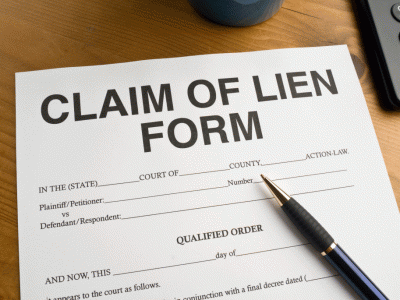
IRS and State Tax Liens: How They Impact Business Credit—and What to Do